Large Area WiFi
We use two approaches to build WiFi networks across large spaces, depending on the area you need to cover and what's practical for the site.
Mesh WiFi
This is the more familiar option. We deploy high-powered outdoor WiFi-6 access points across the site, each covering a radius of roughly 300 to 400 metres. The access points are positioned so their coverage areas overlap, letting devices roam seamlessly between them as people and vehicles move around the property.
Mesh WiFi works well for campuses, warehouses with surrounding yards, outdoor event spaces, and homesteads where you want reliable coverage across the house, sheds, and nearby work areas. The hardware is mature, widely supported, and most devices connect to it without any configuration.
LA-WiFi
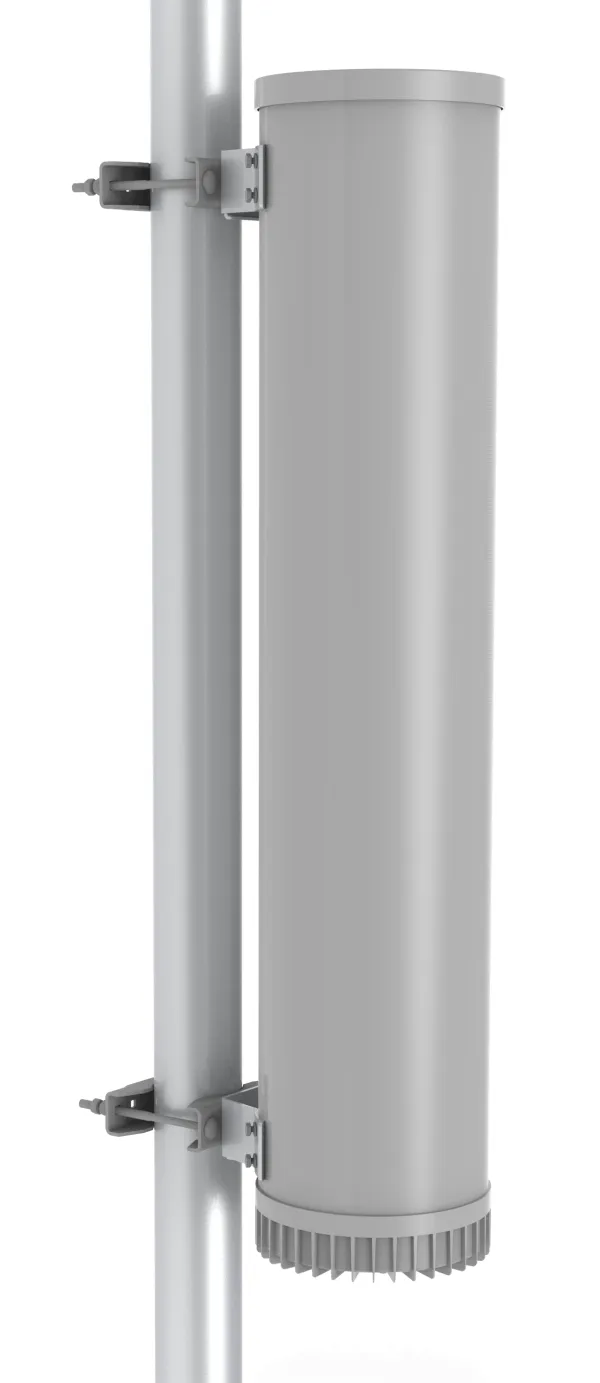
When standard WiFi can't reach far enough, we step up to LA-WiFi. Zettabeam MacroWiFi transmitters can cover up to 1.5 kilometres from a single unit using a wide 180-degree beam with 4x4 MIMO. That's a significant step up from conventional access points.
It's a huge technological leap. While each LA-WiFi transmitter is more expensive than a normal WiFi access point, you need far few of them to cover an equivalent area, not to mention the reduction in ancillary hardware (power, wireless backhaul, cabling, etc.).
One of the key things this technology solves is the hidden-node problem. With normal WiFi over long distances, devices can hear the transmitter but can't hear each other. They end up talking over one another and the network slows to a crawl. MacroWiFi handles this at the protocol level, which is what makes reliable WiFi coverage at these distances possible in the first place.
This suits large rural properties, mine sites, ports, and expansive industrial yards where you need coverage measured in kilometres, not metres.
Private 5G
Recent changes to ACMA spectrum licensing have made Private 5G remarkably affordable, and it opens up a whole new scale of wireless network. The easiest way to think of it: you're setting up your own broadband internet network. Each device gets a SIM card and connects to your transmitter the same way it would connect to Telstra or Optus, except it's your network, covering your site, carrying your data. Coverage areas beyond 5 kilometres are achievable.
Private 5G is a strong fit for operations that need high-speed data across a large site. Autonomous vehicles, real-time fleet tracking, mobile equipment, industrial control systems. You can even make voice calls between devices on the network. The one thing to know is that it's a separate network from the public mobile carriers, so for calls to regular phone numbers, devices would need a second SIM on the public network.
Through our partnership with Axidra we handle the entire process end to end: network design, spectrum licensing with ACMA, hardware supply, installation, and ongoing management. It's more involved than rolling out WiFi, but we take care of the complexity so you don't have to.
LoRa / Sensor Networks
Not every application needs high-speed data. If you're collecting sensor readings across a property, LoRa is a simpler and cheaper way to do it. It uses a narrow channel on the ISM 900 MHz band to achieve broad coverage over long distances, purpose-built for small packets of data rather than streaming or browsing.
LoRa is ideal for telemetry: dam and creek levels, tank monitoring, soil moisture sensors, remote relays and switches. The kind of data that needs to travel a long way but doesn't need much bandwidth to do it.