Why Buildings Block Signal
Modern businesses run on mobile connectivity. Your sales team is taking calls from clients. Warehouse staff are scanning inventory on handheld devices. Visitors expect to walk in and have their phone just work. EFTPOS terminals, QR-code self-service, cloud-based POS systems, assistance robots, building management platforms, security cameras, even the lift emergency phone... all of it depends on reliable mobile signal. When it's not there, you feel it immediately: missed calls, failed transactions, frustrated staff, tenants complaining, and a general sense that the building isn't keeping up.
You've probably noticed it's a growing problem. Two things have changed at the same time, and they've worked against each other. Buildings have become better insulated: energy-efficient window coatings, reinforced concrete, steel framing, foil-backed insulation, and every one of those materials blocks radio signals. At the same time, mobile networks have moved to wider, higher frequency bands to deliver faster speeds and more capacity. The trade-off is that those newer signals are worse at getting through walls. So a building that had passable coverage a few years ago can have noticeably worse coverage today, without anything about the building itself changing.
The deeper into the building you go, the worse it gets. Basements, car parks, stairwells, lift shafts, and internal rooms surrounded by concrete, these are the spots where signal disappears entirely. And for building owners, that's increasingly a liability issue too, particularly when it comes to 000 emergency access in isolated areas like underground car parks, evacuation routes, or spaces where staff work alone.
What We Install
An IBC system works by placing a donor antenna on the roof to capture signal from nearby mobile towers. Cabling brings that signal down to an Access Unit in the building's comms room, which processes and amplifies it. From there, coaxial cable, ethernet or fibre distributes it to Coverage Nodes placed throughout the building. Each node outputs strong, stable signal across its area.
The result is consistent mobile coverage from basement to rooftop, including the spots that are hardest to reach: lifts, stairwells, underground car parks, and building cores.
For medium-sized buildings our platform of choice is the Cel-Fi Quatra by Nextivity. It uses your building's existing structured ethernet cabling, which keeps installation clean and cost-effective. The system is modular, so it scales to any building size, and it self-adjusts to manage interference and maintain consistent performance. We can build for any of the three Australian mobile network operators (MNOs), in any combination, and because our systems operate independently of the carriers there's no lengthy approval process holding up the project.
Design, Install, Monitor
Design
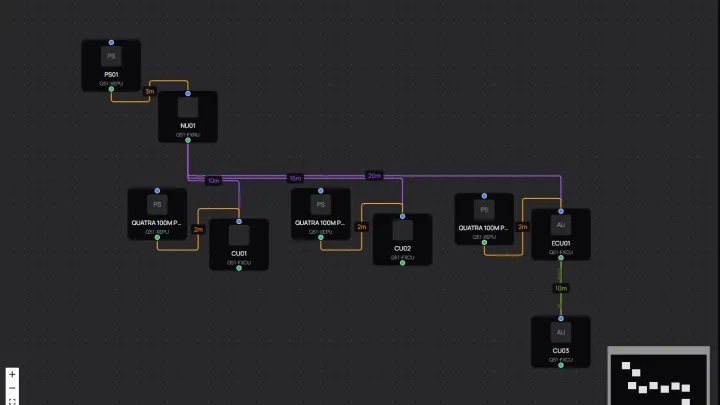
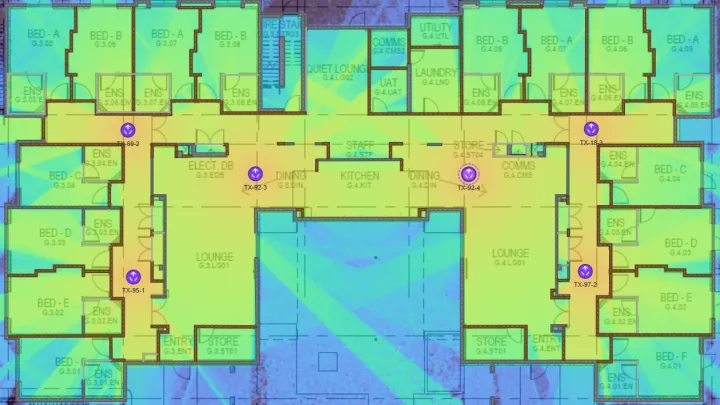
Our design partner Axidra handles the RF engineering. Your floor plans go into Axidra Cloud, which models signal propagation through each level of the building, accounting for walls, pillars, doors, and construction materials.
The system is designed and validated before we set foot on site. For buildings where access to 000 emergency services is a concern (basements, car parks, isolated work areas), coverage in those spaces is factored into the design from the start.
Install
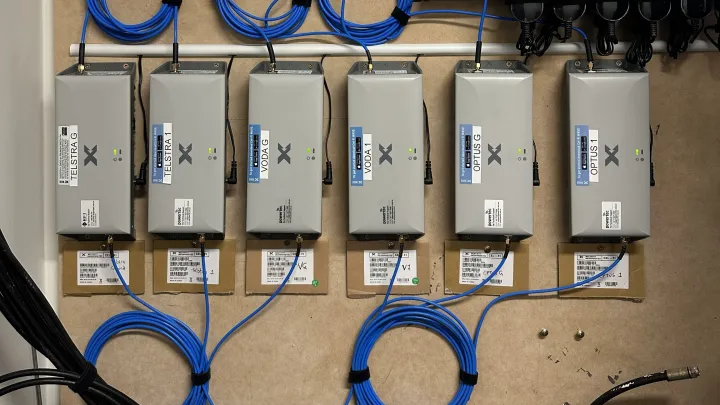
We handle the physical build. Donor antenna on the roof, cabling runs, Access Units in the comms room, Coverage Nodes throughout the building. Our team manages the electrical and communications fit-out end to end.
Typical builds are completed in weeks, not months.
Monitor & Support
Once the system is live, Axidra provides ongoing remote monitoring and 3D visualisation of performance across the building. Issues are flagged before tenants or staff start noticing. The system can be adjusted, expanded, or reconfigured as the building's needs change over time, without starting from scratch.
Depending on your preferred engagement, we'll be out periodically to keep the system ship-shape.
IBC vs Carrier-Led DAS
If you've looked into in-building mobile coverage before, you may have come across the term DAS (Distributed Antenna System). This technically refers to an IBC architecture where antennas are placed (distributed) throughout a building. But in construction tenders, "DAS" may sometimes refer specifically to a carrier-managed system where each mobile network operator installs their own base station equipment into the building. Connection costs alone typically run $100,000 to $300,000 per carrier, and in major venues the total system cost can reach into the millions.
Most commercial and industrial buildings don't need that, and won't attract carrier funding for it. Independently operated IBC systems deliver reliable coverage using DAS architecture at a fraction of the cost, with systems ranging from $5,000 for a small installation to around $250,000 for large, complex buildings. The building owner or IBC infrastructure partner retains control of the system and isn't waiting on a carrier's priorities or timelines.
Carrier-led DAS still has its place in very high-traffic environments like stadiums, airports, and major shopping centres. For most offices, hospitals, warehouses, hotels, apartments, and universities, IBC is the practical and cost-effective choice.
If you've seen DAS requirements in a construction tender and aren't sure what's actually needed, we can help you work through it.
Is IBC Right for Your Building?
Commercial and industrial buildings
IBC's core territory. Offices, hospitals, warehouses, hotels, apartment complexes, universities, retail. Systems scale from a single floor through to multi-building campuses.
Major public venues
with thousands of simultaneous occupants (stadiums, airports, large shopping centres) will generally need carrier-led infrastructure. There are exceptions, and we can advise on those.
Residential properties
our platform and partnership with Axidra is built for commercial operations with portfolio monitoring, multi-site management, and enterprise reporting. If you're a homeowner looking for better mobile signal at home, a simpler repeater system from our store and our team can install it for you.
Congestion, not coverage
sometimes signal bars look fine but calls still drop or data crawls at peak times. That's a capacity issue, not a coverage issue, and the solution is different. We always investigate before recommending, so you don't end up paying for the wrong fix.